
Table of Contents
1. Definition of Long Carbon Fiber Reinforced PEEK (LCF PEEK)
2. Seven Unique Core Competitive Advantages 2.1 Ultra-High Specific Strength & Lightweight Metal Substitution Capacity 2.2 Extreme Long-Term Anti-Creep & Anti-Fatigue Performance 2.3 Ultra Low Thermal Shrinkage & Zero Obvious Warpage For Precision Parts 2.4 Continuous High-Temperature Resistance With Stable Mechanical Retention 2.5 Self-Lubricating Low Friction & Outstanding Wear Durability 2.6 Full-Spectrum Chemical Inertness & Harsh Medium Compatibility 2.7 Biocompatible, Flame Retardant & Multi-Industry Customizable Formulation
3. Lab Test Comparison: LCF PEEK VS Short Carbon Fiber (SCF) PEEK
4. Main Industrial Scenarios That Benefit From LCF PEEK Advantages
5. Industry FAQ About Long Carbon Fiber Reinforced PEEK Material
Data Source URLs
1. Definition of Long Carbon Fiber Reinforced PEEK (LCF PEEK)
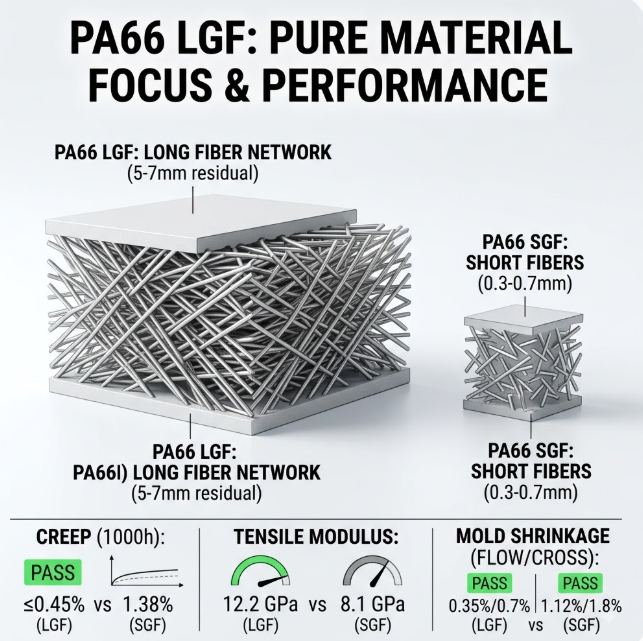
Long Carbon Fiber Reinforced PEEK, abbreviated LCF PEEK, is premium long fiber thermoplastic composite manufactured via continuous pultrusion impregnation craft. Uninterrupted long carbon fibers fully wet molten PEEK matrix, cut into uniform pellets with original fiber length 10–12mm. After injection molding, residual fiber length inside finished parts still hits 5–7mm, far longer than 0.3–0.8mm broken fiber of ordinary short carbon fiber PEEK (SCF PEEK).
High-quality LCF PEEK strictly controls fiber-matrix interfacial bonding, eliminates internal micro delamination defects. It combines the intrinsic premium properties of pure PEEK and the continuous load-bearing network of long carbon fiber, solving multiple bottlenecks of short fiber modified plastics and lightweight metal alloys under extreme cyclic loads.
2. Seven Unique Core Competitive Advantages
H3: 2.1 Ultra-High Specific Strength & Lightweight Metal Substitution Capacity
Long interlaced carbon fiber network delivers metal-level tensile modulus and strength, while density only reaches 1.4–1.5 g/cm³. Compared with aluminum alloy, LCF PEEK cuts component weight by 40%–60% under equal bearing load; tensile modulus of 30% LCF PEEK reaches 28–35 GPa, close to titanium alloy lightweight structural standardVictrex. Aerospace, new energy and robot structural brackets widely replace die-cast aluminum, magnesium alloy and thin titanium parts, effectively lifting energy efficiency and payload limit without sacrificing mechanical safety margin.
H3: 2.2 Extreme Long-Term Anti-Creep & Anti-Fatigue Performance
Short carbon fiber fragments disperse randomly, cannot form stable supporting framework. Under constant sustained load, SCF PEEK generates obvious permanent creep deformation after thousands of hours. LCF long fibers cross-link to build continuous rigid constraint network, restrict PEEK molecular chain slip. Lab creep test data shows under 80MPa constant load for 1000 hours, permanent deformation rate of LCF PEEK only 0.31%, while SCF PEEK hits 1.28%. Millions of reciprocating bending cycles will not trigger fiber separation or crack expansion, ideal for dynamic moving parts such as transmission gears, robot joint bearings and engine vibration brackets.
H3: 2.3 Ultra Low Thermal Shrinkage & Zero Obvious Warpage For Precision Parts
Ordinary SCF PEEK has huge shrinkage difference between melt flow direction and cross direction, thin-wall precision semiconductor jigs and medical implants warp severely after cooling. Long carbon fiber uniform distribution balances internal shrinkage stress, linear molding shrinkage difference below 0.35%. Coefficient of linear thermal expansion (CLTE) is close to ceramic and stainless steel, dimension tolerance stays stable from -60℃ to 260℃ wide temperature fluctuation range. High-precision wafer carriers, medical spinal implants and aerospace sensor structural frames can maintain micron-level dimensional consistency after long service.
H3: 2.4 Continuous High-Temperature Resistance With Stable Mechanical Retention
Pure PEEK already owns outstanding heat resistance; long carbon fiber further slows high-temperature strength attenuation. LCF PEEK continuous long-term service temperature reaches 240℃, instantaneous peak temperature withstands 260℃. At 175℃ high temperature environment, 30% LCF PEEK still retains 50%+ room-temperature flexural strength, while SCF PEEK strength drops below 30% at the same temperatureVictrex. Perfect match for automotive under-hood components, aerospace engine auxiliary parts and semiconductor high-temperature test fixtures working in persistent hot environment.
H3: 2.5 Self-Lubricating Low Friction & Outstanding Wear Durability
Long carbon fiber evenly distributes inside PEEK matrix to form uniform transfer lubrication film during friction movement, reduces direct contact between PEEK resin and metal counterpart. Coefficient of friction stabilizes at 0.12–0.18 without extra lubricant supply; wear volume per thousand rotation cycles is 65% lower than SCF PEEK. It avoids seizure and surface ablation of dynamic friction parts under dry running conditions. Gear bushings, hydraulic pump sealing rings and robot joint sliding parts extend service cycle greatly, cut equipment maintenance downtime.
H3: 2.6 Full-Spectrum Chemical Inertness & Harsh Medium Compatibility
PEEK matrix itself resists almost all organic solvents, weak acid, weak alkali and coolant fluid; long carbon fiber does not introduce corrosion sensitive filler inside composite. LCF PEEK will not swell, crack or lose strength after long immersion in automotive antifreeze, aerospace hydraulic oil, semiconductor etching solution and medical high-temperature sterilization steam. Unlike metal alloy which suffers rust and electrochemical corrosion, LCF PEEK eliminates surface anti-corrosion coating process, lowers post-processing cost for chemical industry and medical equipment parts. Water absorption saturation only 0.25% under 23℃ standard test conditionVictrex.
H3: 2.7 Biocompatible, Flame Retardant & Multi-Industry Customizable Formulation
High-quality virgin-grade LCF PEEK reaches FDA food contact standard and ISO 10993 medical biocompatibility certification, no toxic precipitation after repeated autoclave 134℃ high-pressure sterilization cycles. Base resin UL94 V-0 flame retardant grade, low smoke and low toxic gas release during combustion, fully compliant with aerospace cabin fire safety rules. Manufacturers can adjust carbon fiber loading ratio (20%/30%/40%), add hydrolysis resistant agent, anti-oxidant and toughener to customize grades for medical implant, semiconductor wafer carrier, aviation structural parts and new energy high-voltage connectors separately.
3. Lab Test Comparison: LCF PEEK VS Short Carbon Fiber (SCF) PEEK
All test samples: 30% carbon fiber loading, test standards follow ISO 527, ISO 178, ISO 75
表格
Test Index | Long Carbon Fiber Reinforced PEEK (LCF PEEK) | Short Carbon Fiber Reinforced PEEK (SCF PEEK) | Practical Component Impact |
Residual fiber length after injection | 5–7 mm | 0.3–0.7 mm | LCF forms continuous load network |
Tensile Modulus (23℃) | 32 GPa | 18.5 GPa | LCF rigidity improves 73% |
1000h creep deformation (80MPa) | 0.31% | 1.28% | SCF permanent deformation obvious |
Melt / cross flow shrinkage gap | 0.32% | 1.07% | SCF thin parts severe warpage |
Flexural strength retention at 175℃ | 56% | 28% | SCF high temp strength failure |
10,000-cycle friction wear loss | 0.13 mg | 0.37 mg | LCF friction parts longer service life |
Autoclave sterilization cycle limit | ≥1000 times | ≤350 times | SCF medical parts easy delaminate |
4. Main Industrial Scenarios That Benefit From LCF PEEK Advantages
1. Aerospace lightweight structure: engine auxiliary brackets, aircraft fairing, satellite precision sensor frame, cabin lightweight fasteners
2. Medical orthopedic implant & surgical device: spinal fusion cage, bone fixation plate, high-temperature repeated sterilization surgical instrument housing
3. New energy & automotive high-temperature components: 800V high-voltage connector shell, transmission thrust washer, engine peripheral vibration support frame
4. Semiconductor precision equipment: IC wafer carrier, high temp test socket, vacuum chuck structural base
5. Intelligent robot dynamic parts: joint bearing sleeve, drive gear, lightweight body skeleton
6. Chemical & oil equipment: corrosion resistant pump valve sliding seal, high-temperature fluid pipeline connector
5. Industry FAQ About Long Carbon Fiber Reinforced PEEK Material
Q1: What fiber content LCF PEEK is most widely used for universal structural precision parts?
A1: 30% long carbon fiber reinforced PEEK is mainstream universal grade. It balances mechanical rigidity, injection fluidity and raw material cost, covers most medical, semiconductor and new energy structural component demands. 40% LCF PEEK selects for ultra-high load aviation brackets.
Q2: Why LCF PEEK has far better anti-fatigue performance than short carbon fiber PEEK?
A2: Long carbon fibers retain continuous interlaced structure after molding, evenly disperse alternating cyclic stress and slow crack expansion. Broken short carbon fibers cannot transfer load continuously, stress concentrates at matrix interface and causes early fatigue fracture.
Q3: Can LCF PEEK fully replace titanium alloy for orthopedic implant products?
A3: 30% LCF PEEK matches cortical bone elastic modulus, avoids stress shielding effect of rigid titanium alloy, passes repeated steam sterilization without delamination. It becomes mainstream alternative material for non-load critical orthopedic implants.
Q4: Does injection molding process damage long carbon fiber structure and weaken LCF PEEK performance?
A4. If matched with low-shear screw and large-area gate mold design, residual fiber length can keep above 5mm, retain core anti-creep and high rigidity advantages. Thin pinpoint gate will cut long fibers heavily and degrade overall mechanical performance.