
1. Introduction
The automotive industry has a weight problem. Literally. Every kilogram added to a vehicle increases fuel consumption and reduces range. For electric vehicles, the penalty is even steeper—heavier cars need bigger batteries, which add more weight, which reduces efficiency. This cycle is a major challenge for engineers trying to meet emissions regulations and consumer expectations.
Lightweighting is the answer. And one of the most effective materials for the job is long glass fiber-reinforced polypropylene, or LGF-PP. It offers the strength of engineering plastics at a fraction of the weight of metal. It can replace steel and aluminum in structural and semi-structural components. It's cost-effective, processable, and increasingly the material of choice for automakers worldwide.
This review examines how LGF-PP enables vehicle lightweighting, the performance data behind it, and what engineers need to know when specifying it.
2. What Is LGF-PP and How Does It Compare to Short-Fiber PP?
LGF-PP is a composite material where polypropylene is reinforced with glass fibers typically ranging from 10 to 25mm in length . This distinguishes it from short glass fiber-reinforced polypropylene (SGF-PP), which uses fibers in the 0.2–0.6mm range .
The fiber length difference matters. In SGF-PP, the fibers are too short to form a continuous reinforcing network. They improve stiffness and heat resistance, but they don't significantly enhance impact strength or creep resistance. In LGF-PP, the long fibers form a three-dimensional skeletal network throughout the part. This network transfers load efficiently, absorbs impact energy, and resists deformation under sustained stress .
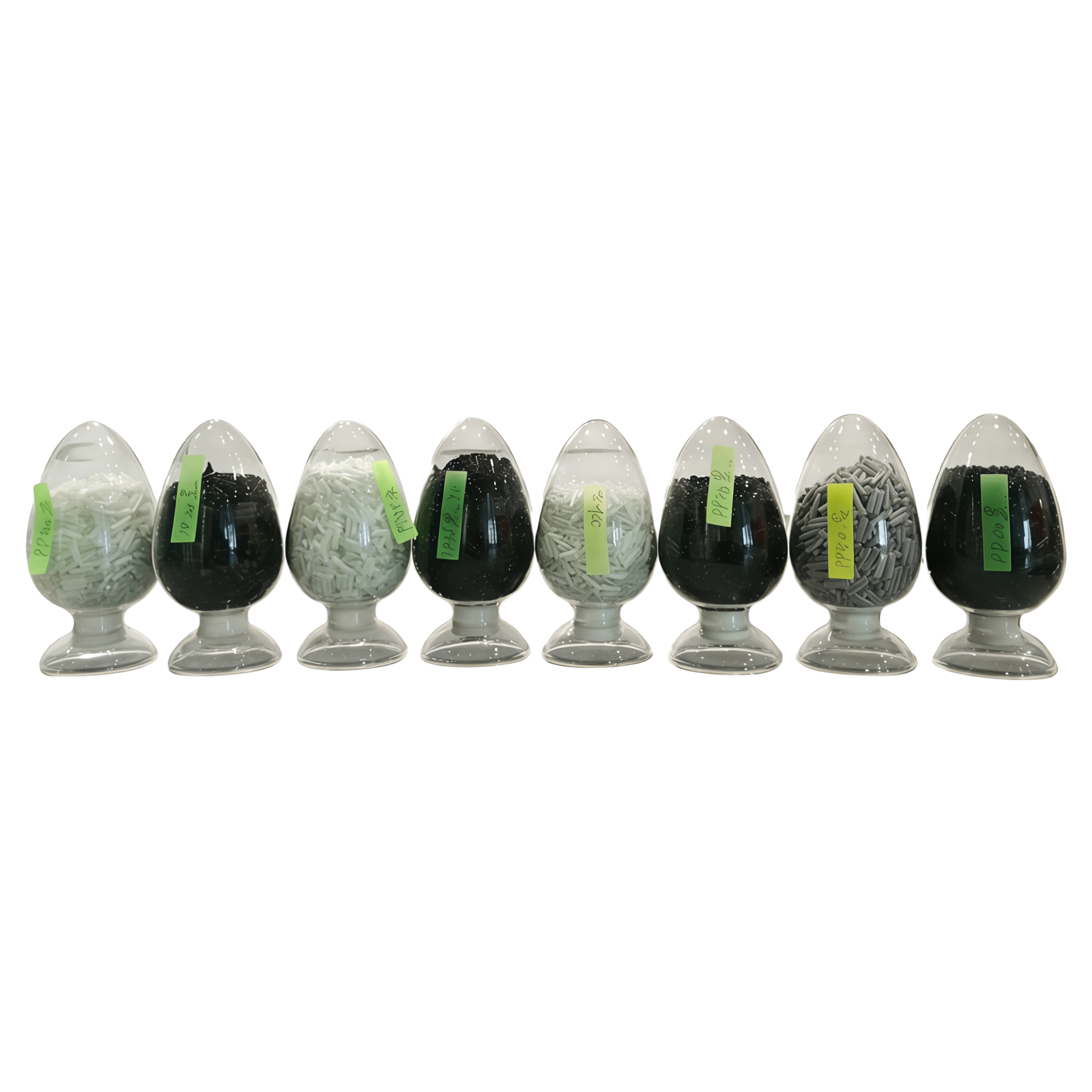
How LGF-PP is made. LGF-PP pellets are produced through a pultrusion process. Continuous glass fiber rovings are impregnated with molten PP, then pelletized. The fibers run the full length of the pellet—typically 10–12mm or more. When injection molded, the fibers remain longer than those in SGF-PP, preserving the reinforcing network .
3. The Lightweighting Effect – Real Weight Savings
The density of LGF-PP is approximately 1.2 g/cm³—about 45% of aluminum (2.7 g/cm³) and roughly 15% of steel (7.8 g/cm³) . This density advantage translates into substantial weight savings when replacing metal components.
Real-world examples:
BMW uses LGF-PP for instrument panel carriers, achieving a 20% weight reduction compared to traditional materials .
SABIC reports that battery enclosures manufactured with flame-retardant LGF-PP achieve over 20% weight reduction compared to metal alternatives .
For front-end modules, LGF-PP replaces more than ten individual metal components, reducing weight by approximately 30% .
Seat backrests made with LGF-PP instead of steel achieve a 20% weight reduction while maintaining structural integrity .
Why this matters for fuel consumption. Every 100 kg of weight reduction in a conventional vehicle reduces fuel consumption by roughly 0.3 to 0.5 liters per 100 km. In electric vehicles, weight reduction directly extends range—every kilogram saved contributes to battery efficiency and overall performance.
4. Performance That Matters – Strength, Impact, and Durability
Lightweighting only works if the material can handle the loads. LGF-PP delivers across multiple performance metrics.
Mechanical properties. Studies show that LGF-PP composites maintain excellent mechanical properties even under thermal aging. After 40 days of aging at 120°C, tensile strength decreased by only 2.39%, while impact strength retention exceeded 87% . This demonstrates that LGF-PP parts remain durable over extended service life.
Impact resistance. The three-dimensional fiber network in LGF-PP absorbs impact energy more effectively than SGF-PP. When subjected to impact loads, the fibers distribute stress throughout the network, preventing localized failure .
Creep resistance. LGF-PP resists creep even at temperatures up to 100°C. This is critical for components under sustained loads, such as seat structures and instrument panel carriers .
Thermal stability. Flame-retardant grades of LGF-PP achieve UL94 V-0 ratings, making them suitable for battery enclosures and other high-risk applications .
Dimension stability. LGF-PP exhibits low warpage and anisotropic properties—meaning the material behaves similarly in all directions. This is a significant advantage over SGF-PP, which tends to warp due to fiber orientation effects .
5. Material Selection and Processing Considerations
LGF-PP is not a drop-in replacement for SGF-PP or metal. Processing parameters and material selection require careful engineering attention.
Resin selection impacts properties. The matrix resin's melt flow rate affects final fiber length. Higher melt flow rates allow the fibers to survive processing with greater length retention, enhancing mechanical properties . Copolymer PP generally produces better impact strength than homopolymer PP, though other properties may be slightly lower .
Fiber length retention is critical. Injection molding of LGF-PP requires processing conditions that minimize fiber breakage. Screw design, melt temperature, and injection speed all affect final fiber length. Some suppliers offer LGF-PP grades optimized for specific processing conditions .
Cost considerations. While LGF-PP is more expensive than SGF-PP on a per-kilogram basis, the system-level economics are favorable. LGF-PP injection molds cost approximately 20% of metal stamping dies. Parts can integrate multiple components into a single molded unit, reducing assembly costs, tooling costs, and parts inventory .
6. The EV Connection – Why LGF-PP Matters for Electric Vehicles
Electric vehicles are heavier than internal combustion vehicles due to battery packs. Lightweighting is essential to offset this weight penalty and maximize driving range. This has created a surge in demand for LGF-PP.
Battery enclosures and trays. LGF-PP is replacing steel and aluminum in EV battery housings. Flame-retardant grades with UL94 V-0 ratings provide thermal protection while reducing weight by over 20% . The material also offers corrosion resistance and design flexibility for complex geometries.
Front-end and structural modules. EVs benefit from part consolidation. LGF-PP enables the integration of multiple components—sensors, cooling lines, mounting brackets—into a single front-end module, simplifying assembly and reducing weight .
Market growth. The global automotive GFPP market is projected to grow from $3.5 billion in 2025 to $5.4 billion by 2032, driven largely by EV lightweighting requirements. LGF-PP accounts for approximately 70% of the market due to its superior structural performance .
7. Conclusion
LGF-PP has emerged as one of the most effective materials for vehicle lightweighting. It combines the low density of polypropylene with the strength, impact resistance, and durability of long glass fiber reinforcement. Real-world applications—from BMW instrument panels to EV battery enclosures—demonstrate weight reductions of 20% or more while maintaining structural performance.
The shift toward electric vehicles is accelerating demand for LGF-PP. The need to offset battery weight and maximize range makes this material particularly valuable. With its favorable system-level economics and established manufacturing processes, LGF-PP is positioned to play a central role in automotive lightweighting for years to come.
8. Frequently Asked Questions (FAQ)
Q: What is the difference between LGF-PP and SGF-PP?
A: LGF-PP uses glass fibers 10–25mm long, which form a three-dimensional reinforcing network that enhances impact strength, creep resistance, and dimensional stability. SGF-PP uses fibers 0.2–0.6mm long, providing good stiffness and heat resistance but significantly lower toughness and load-bearing capability .
Q: How much weight can LGF-PP save compared to metal?
A: LGF-PP reduces component weight by 20–50% compared to metal. Typical automotive applications achieve 20–30% weight savings over steel or aluminum .
Q: Is LGF-PP suitable for flame-retardant applications?
A: Yes. Flame-retardant grades of LGF-PP achieve UL94 V-0 ratings at 1.5mm thickness. These materials are used in EV battery enclosures and other applications requiring thermal protection .
Q: Does LGF-PP maintain its properties under thermal aging?
A: Yes. Studies show that after 40 days at 120°C, LGF-PP retains over 87% of its impact strength and experiences less than 2.5% tensile strength loss .
Q: What are the processing challenges with LGF-PP?
A: LGF-PP requires careful processing to maintain fiber length. Screw design, melt temperature, and injection speed affect final fiber length. Suppliers offer grades optimized for specific processing conditions .
Q: How does the cost of LGF-PP compare to metal?
A: LGF-PP is more expensive on a per-kilogram basis than steel, but system-level costs are competitive. Mold costs are approximately 20% of metal stamping dies. Part consolidation reduces assembly and inventory costs .